
In his opening remarks at a ministerial meeting in Tokyo of the Quadrilateral coalition, also known as 'Quad', External Affairs Minister S Jaishankar said India remained committed to a rules-based world order, respect for territorial integrity and sovereignty, and peaceful resolution of disputes.

China, which has territorial disputes with many countries in the strategic Indo-Pacific region, has been opposing the Quad alliance since its formation.
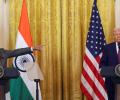
Prime Minister Narendra Modi spoke with President Donald Trump and set the record straight that India had paused strikes on Pakistan during Operation Sindoor following a request from Islamabad and not due to mediation or offer of a trade deal by the United States.
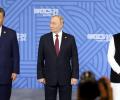
China has expressed its support for Russia's initiative to revive the Russia-India-China (RIC) troika, emphasizing its importance for regional and global security and stability.
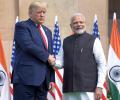
Prime Minister Narendra Modi and US President Joe Biden will have a substantive engagement on the sidelines of the Quad summit on Saturday, and the two sides will sign at least two agreements following the talks.

The bilateral and Quad summits, in which Prime Minister Modi played a significant role, has sent the right message to China, observes Ambassador T P Sreenivasan.
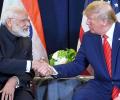
It would be the prime minister's first bilateral visit to the US after Trump became president for a second term.
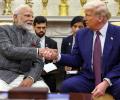
A US lawmaker and former officials warn that President Trump's policies are damaging the strategic partnership between the United States and India, potentially driving India closer to China and Russia.
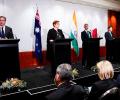
India is a driving force of the Quad and an engine for regional growth, said the White House, days after foreign ministers of the countries, which are part of the grouping, met in Melbourne.

The leaders of the Quad comprising India, the United States, Australia and Japan are set to demonstrate that the grouping is a 'force for global good' and has a unifying commitment to a rules-based international order amid China's increasingly intimidatory behaviour.

'We should watch -- in the near term -- for signs that the two have totally fallen out at a personal, political level.' 'Trump and Modi know how to be dealmakers, but they also know how to hold a grudge.'
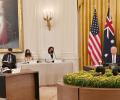
Answering a question about whether Biden will raise the issue of a unified response to Russia, White House Press Secretary Jen Psaki said, "We will convey the same sentiments in this meeting."
The foreign ministers of the Quad grouping of India, the US, Australia and Japan on Friday held extensive talks in Melbourne amid escalating tension between Russia and NATO countries over Ukraine, the Afghan crisis and increasing concerns over China's "coercion" in the Indo-Pacific region.
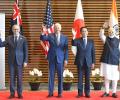
Biden welcomed Prime Minister Modi at the Summit and said "it is wonderful to see you again in person".

India on Thursday said it expects the United States to consider visa applications of Indian students on merit amid growing concerns over the Trump administration halting new student visa interviews.
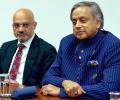
Tharoor said that though India's case might not be at the top of the agenda for the US media, India can get its message across easily.

"No one has ever accused India of supporting what is going on in Ukraine. What India seems to be doing is trying to operate within the policy outlined by Nehru 65 years back," said a source.
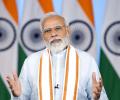
He said he will be visiting Tokyo at the invitation of his Japanese counterpart Fumio Kishida, and noted that in March 2022, he had hosted Kishida for the 14th India-Japan Annual Summit.

Prime Minister Narendra Modi has held talks with Ukrainian President Volodymyr Zelenskyy and reiterated India's commitment for an early resolution of the conflict in Ukraine and the restoration of peace and stability in the region.

More than India's alignment with the Quad, India's defence cooperation and partnership with the USA is of critical importance, notes Rup Narayan Das.
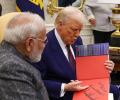
'The current strain in the relationship is serious and likely to be long lasting.' 'Even if Trump suddenly changes his attitude toward India -- which he is entirely capable of doing -- it is unlikely that New Delhi will be able to pick up the pieces and respond as if nothing has happened.'

This is the first time that the National Security Council has held a meeting with these Sikh activists and Sikh separatists.

Remarks from Indian External Affairs are significant as it comes after China slammed Quad and said the formation of "exclusive cliques" targeting other countries runs counter to the trend of the times and is "doomed to fail".

Four-nation grouping Quad on Tuesday launched a major new initiative for the Indo-Pacific that allows the partner countries to fully monitor the waters on their shores and help ensure peace and stability in the region, a move that comes amid China's increasingly intimidatory behaviour.
India, Australia, Japan and the US on Friday pledged to work together for ensuring peace and prosperity of the Indo-Pacific and the world, as top leaders of the Quad grouping announced a slew of new initiatives to take on common challenges, amidst muscle flexing by an assertive China in the strategic region.
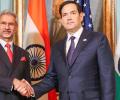
The phone conversation came amid escalating tensions between India and Pakistan over the April 22 terror attack that killed 26 civilians.

According to Misri's statement, Modi said he could not accept the invitation due to a pre-existing schedule, and invited Trump to visit India for the Quad Summit, likely later this year.
China's behaviour in the post-pandemic geopolitical landscape which may determine the Quad's future trajectory, notes former foreign secretary Shyam Saran.

Prime Minister Modi held separate talks with world leaders including his Nepalese counterpart K P Sharma Oli, and Palestinian President Mahmoud Abbas, discussing various facets of bilateral ties and reaffirmed India's support for the Palestinian people.
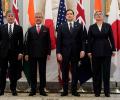
India has always been open to legitimate return of undocumented Indians to their country, External Affairs Minister S Jaishankar said on Wednesday, noting that New Delhi is still in the process of verifying those from the United States who can be deported to India and the number of such individuals cannot be determined yet.

Trump's method are more destabilising than his policy. So, a good idea these couple of years is to sip Kool-Aid, and savour the joys of Trumplomacy, asserts Shekhar Gupta.

Prime Minister Narendra Modi along with his counterparts from Australia and Japan on Friday attended the first in-person meeting of Quad leaders hosted by US President Joe Biden during which they plan to discuss issues like climate change, Covid-19 pandemic and challenges in the Indo Pacific, amidst China's growing military presence in the strategic region.

In the midst of rising global concern over China's military expansionism, India and three other member nations of the Quad on Thursday vowed to uphold a rules-based international order underpinned by respect for territorial integrity and sovereignty, freedom of navigation and peaceful resolution of disputes.

Leaders of the United States, India, Australia and Japan did discuss the 'challenge' posed by China during the first meeting of the Quad, and they made clear that none of them have any 'illusions' about Beijing, US National Security Advisor Jake Sullivan has said.
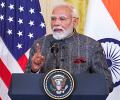
Those who stay in other countries illegally do not have any legal right to be there, Modi said.

The Quad has emerged as a key grouping to work for peace, progress, and prosperity in the Indo-Pacific region, Prime Minister Narendra Modi said on Saturday as he left for the United States on a three-day visit.
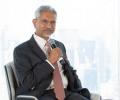
Jaishankar said that the Pahalgam attack "was an act of economic warfare. It was meant to destroy tourism in Kashmir, which was the mainstay of the economy. It was also meant to provoke religious violence because people were asked to identify their faith before they were killed."

Leaders of India, Australia and the United States -- countries that make up the Quad with Japan -- expressed shock at the assassination of former Japanese Prime Minister Shinzo Abe, saying he played a 'formative role' in the founding of the partnership and worked tirelessly to advance a shared vision for a free and open strategically-important Indo-Pacific region.

Interestingly, in his entire remarks, Modi never once mentioned regional security, Ambassador M K Bhadrakumar points out.
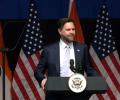
US Vice President JD Vance called on India to drop non-tariff barriers, give greater access to its markets and buy more American energy products and military hardware. Vance, in a speech in Jaipur, highlighted the need for a stronger US-India partnership for a prosperous and peaceful 21st century. He emphasized the importance of working together to address global challenges and praised Prime Minister Narendra Modi, describing him as a "special person." Vance also urged India to provide greater market access to American products and buy more defense platforms and energy from the US. He suggested that India consider dropping some of the non-tariff barriers for American access to the Indian market and highlighted the benefits of closer India-US defense collaboration, advocating for New Delhi to procure more military hardware from the US. He cited the example of American fifth-generation F-35s, arguing they would give the Indian Air Force the ability to defend its airspace and protect its people like never before. Vance also welcomed the Modi government's budget announcement to amend India's civil nuclear liability laws, paving the way for US producers to export small modular reactors and build larger US-designed reactors in India. He emphasized the importance of energy security for India's AI ambitions, stating "there is no AI future without energy security and energy dominance." Vance's visit comes amid growing global concerns over the US's tariff war.
